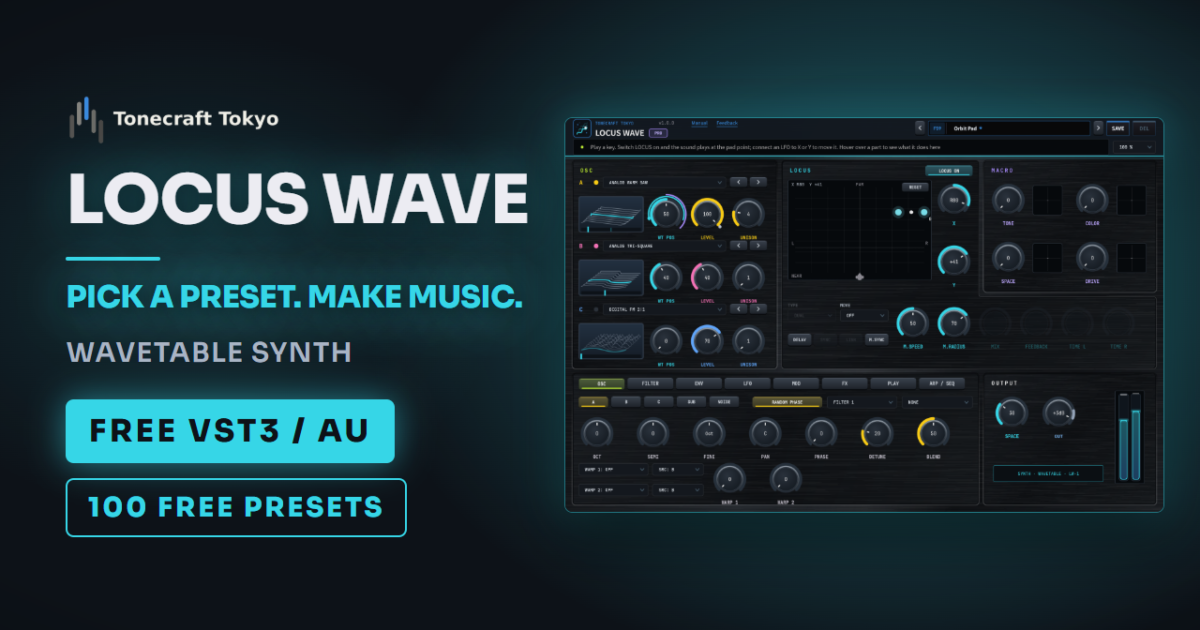
An EDM drop usually comes down to four layered synth parts: bass, chords, plucks and lead. Here they are built one at a time in the free wavetable synth LOCUS WAVE.
- Think of the synths as four parts: bass, chords, plucks and lead
- Split the bass into an offbeat mid bass and a sustained sub, and the low end stays clean
- Layer short chord stabs with a sustained pad
- Cut the kick and bass for the two bars before the drop
- Every synth sound here is a preset in the free version of LOCUS WAVE
The finished track (26 seconds), with each part coming in one after another.
The arrangement
128 BPM, with the chords Am–F–C–G, one per bar, as a four-bar loop. It is a common EDM progression, neither too dark nor too bright.
| Bars | Part | LOCUS WAVE presets |
|---|---|---|
| 1–2 | Bass | Reese Bass + Sub Bass |
| 3–4 | Chords | Super Saw Chords + Super Saw Pad |
| 5–6 | Pluck | Ping Pong Pluck |
| 7–8 | Lead (build-up) | Super Saw Lead + Noise Riser |
| 9–14 | Drop | Everything + Impact |
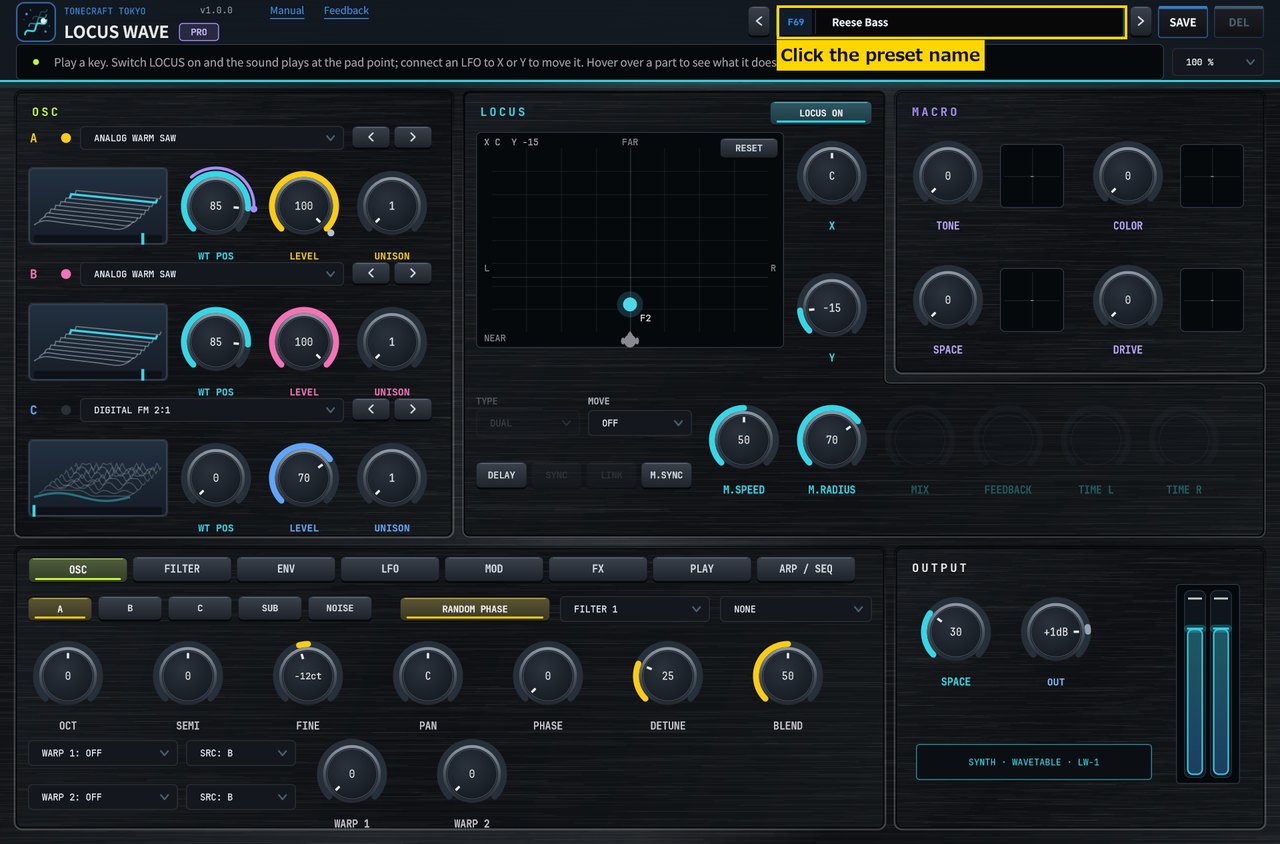
To load a preset, click the preset name in the plugin header and pick it from its category.
Bass: an offbeat mid bass and a sustained sub
With Reese Bass, play the root of each chord on the offbeats, exactly halfway between the kicks. Alternating the kick and bass keeps them from clashing and gives the groove its bounce.
Under it, hold Sub Bass for the whole bar, one octave lower. Keep Reese Bass around F2 to C3 (A2, F2, C3 and G2 in this track), and the low end won’t get muddy.
Chords: stabs plus a pad
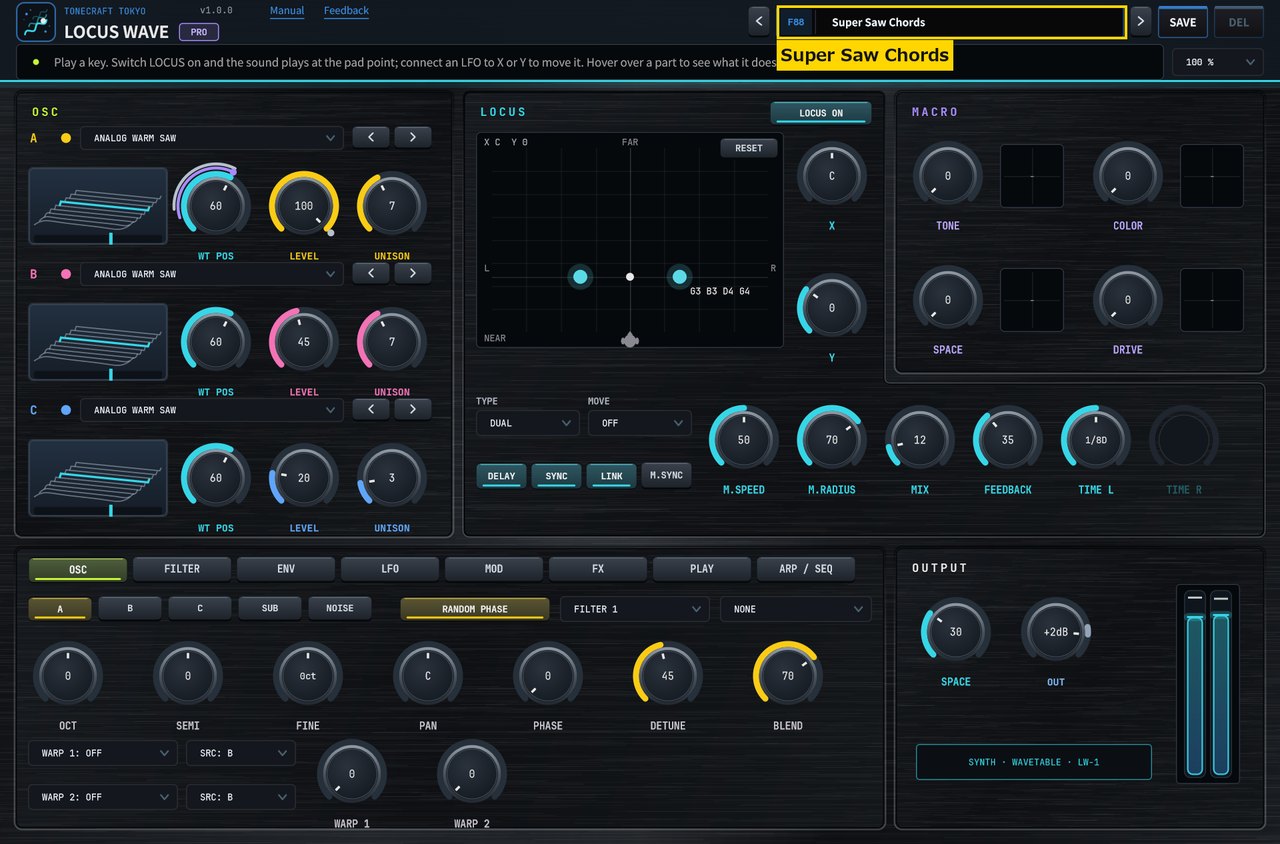
Use Super Saw Chords for four-note chord stabs on the offbeats, like the bass. Layer Super Saw Pad with it, holding the same chords for the whole bar.
Stabs alone leave gaps, and a pad alone has no groove. Together you get rhythm and body.
Pluck: an eighth-note arpeggio for movement
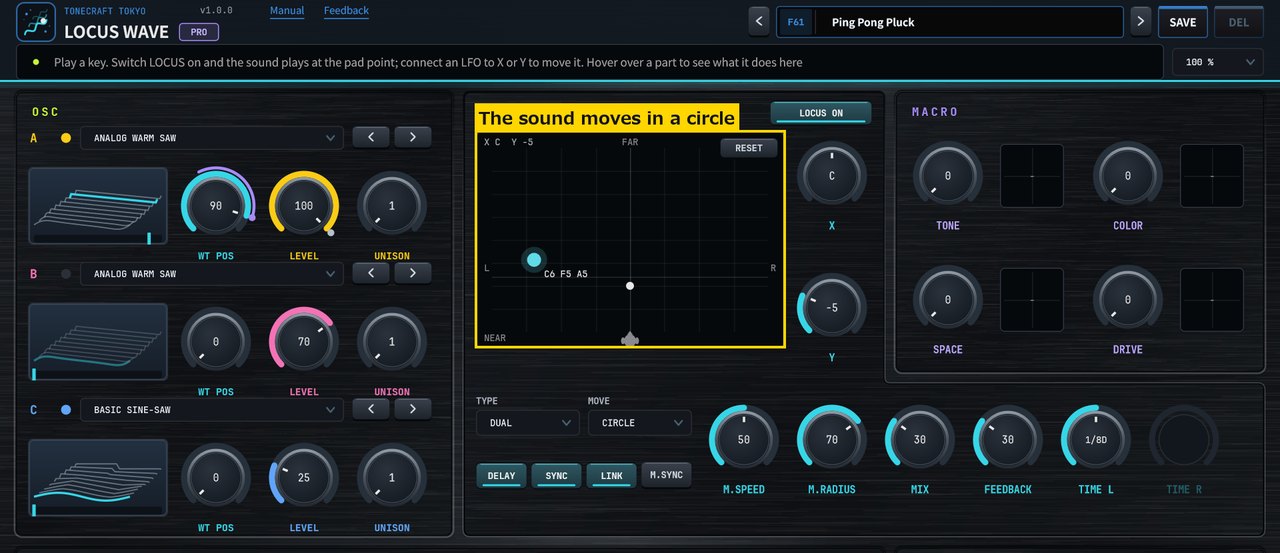
Ping Pong Pluck runs an eighth-note up/down arpeggio through the chord notes. Play it an octave above the chords so it stays out of the other parts’ way.
This preset has MOVE in the LOCUS panel set to CIRCLE, so the sound and its delay repeats orbit around the stereo field. This spreads the phrase out, which is especially noticeable on headphones.
Lead and build-up: cut things out
Write a four-bar melody with Super Saw Lead, and double it an octave up. The octave layer adds thickness and helps it cut through the mix.
For bars 7 and 8, right before the drop, cut the kick, the bass and the chord stabs. Bring in Noise Riser (FX category), a noise sweep that rises over two bars. When everything comes back on the next downbeat, it hits much harder.
Drop: bring it all back and set it moving
On bar 9, bring everything back and add one hit of Impact (FX category) on the downbeat.
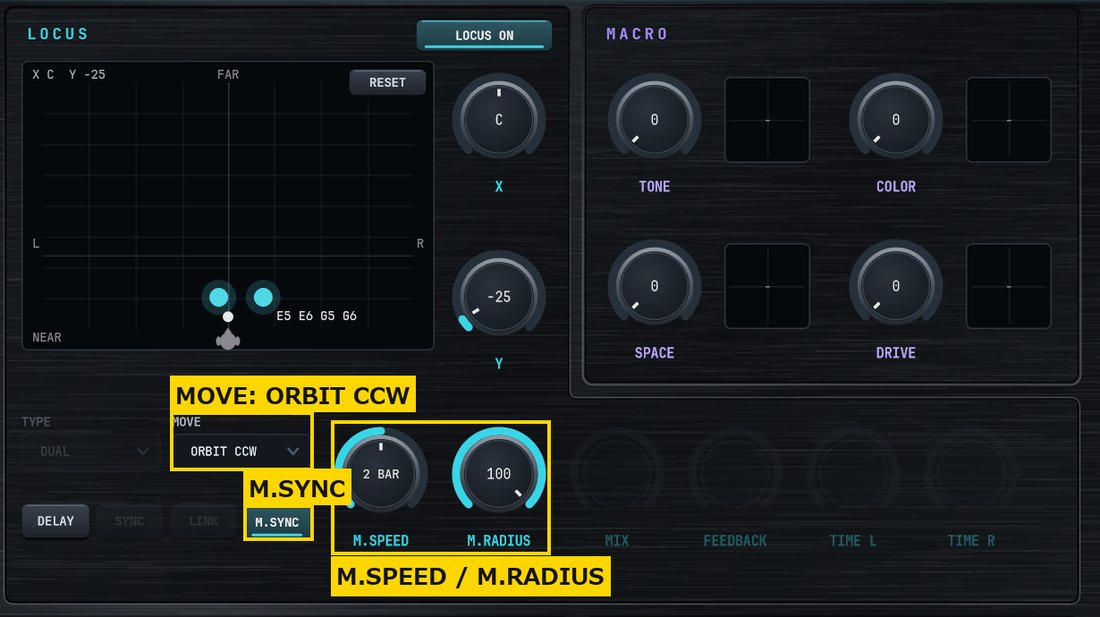
The pad and lead circle around the listener’s head. For the lead, set MOVE in the LOCUS panel to ORBIT CCW (counterclockwise). Turn on M.SYNC, set M.SPEED to 2 bars and M.RADIUS (orbit radius) to 100. For the pad, set the direction to ORBIT CW (clockwise) and M.SPEED to 1 bar. The two parts circle in opposite directions at different speeds.
Ducking the synths a little on every kick gives the familiar sidechain pumping. Insert a compressor on your synth bus in your DAW and route the kick track to its sidechain input.
Free drums too
The kick in this track is ANVIL and the percussion is VARIANZ DRIFT. Both are free drum plugins.
Try it in LOCUS WAVE
LOCUS WAVE is a wavetable synth. It lets you place sounds anywhere across the stereo field and front to back, and keep them moving as they play. The free version is fully featured and includes 100 presets. LOCUS WAVE Pro has 500 presets and 200 wavetables. Every control is explained in the manual. It runs on Windows and Mac.